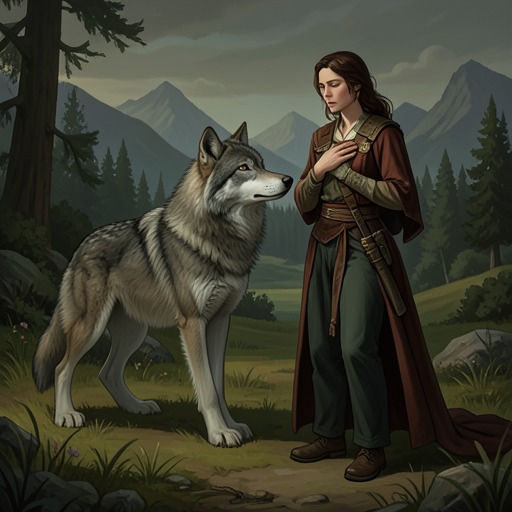
Lycanthropy
How to Flirt with A Naked WerewolfLycanthropy is an inherited capacity to transform between human and wolf forms, but in Cooper’s story it is more than a bodily change: it connects ancestry to pack leadership, territory, violence, and lifelong partnership. The transformation can happen in moments, yet the instincts and obligations attached to it govern choices made even when a wolf is living far from the packlands.
Inheritance and Pack Life
The account Cooper gives Mo traces the ability to an ancestral story rather than to a deliberate act of magic. His grandfather believes that a Northern Man, possibly from Russia or Northeast Asia, married a woman of the valley and that the mixing of their bloodlines produced the first wolf-sons. During a bitter winter, when hunters could not find enough food and people were starving, the older son wished for the strength to provide for his family and neighbors. He transformed; his brother followed, and together they hunted and gathered enough to feed the village. The story presents Lycanthropy as an inherited capacity arising within a particular community and answering an urgent need for survival.
Across later generations, that inheritance became the basis of packs. Evie explains that every generation produces a pack and that each pack has a leader. Those able to transform are not distributed equally across Cooper’s wider family: Evie’s branch is a Dead line, while Cooper’s generation has been able to change. Cooper’s grandfather regards the increasing number of Dead lines, as families marry outside the pack, as a possible safeguard against inbreeding. The ability therefore marks lineage, but its absence does not make a family branch unrelated to the community.
Instinct, Territory, and Leadership
Transformation also places demands on where a wolf lives. Cooper was among the first children of his generation to become a wolf, and his speed and strength made him the expected alpha. He nevertheless left the packlands, where his family lived, and moved about a hundred miles away to Grundy. Evie describes the separation as exceptionally difficult: a wolf’s instincts are oriented toward protecting, hunting, and living in a particular territory, and Cooper’s body continually drew him home. His departure was a struggle against an enduring territorial pull, not simply a change of address.
The ability to transform also underlies the expectations placed on Cooper as a leader. About a year after he became alpha, an invading pack led by Jonas seized Maggie and threatened to kill her unless Cooper surrendered the valley. Cooper froze rather than answering the threat. When Jonas moved to attack Maggie, Cooper changed before she could, intervened, and killed Jonas; in a rare clear memory from wolf form, he recalls killing the other pack’s members as well. Twelve wolves from the invading pack were dead by the time Cooper returned to human form. His capacity to transform made decisive defense possible, but the episode also left him with memories and guilt that shaped how he understood his own leadership.
The Body in Human and Wolf Forms
The changes Cooper undergoes are depicted as immediate and visible. When he runs from Mo, his clothes fall as he shifts midair, and he disappears into the woods on his paws. Later, the sound of his running reaches Mo before she sees the reflected glint of his blue-green eyes; the transition from wolf to man no longer shocks her, having become familiar as part of him. After Cooper leaves again, he remains in wolf form for a week, watching Mo’s house and accompanying her to and from her truck. He can shift back to human form to speak with her, demonstrating that the two forms can alternate within an ongoing relationship and daily routine.
The changes are not visually identical in every wolf. When Eli begins transforming, his eyes become completely yellow and his cheekbones protrude; a shadow seems to move over his skin, unlike the light of transformation Mo associates with Cooper. Later, Eli’s features stretch and his body drops to all fours, blocking Mo’s way out before he lunges at her. The contrast makes transformation legible not only as a change of shape but as a sign of the danger confronting her.
Memory, Kinship, and Consequences
Wolf form does not erase Cooper’s memory, although his recollection is uneven. He describes killing Jonas’s pack as one of his rare clear memories as a wolf. That clarity makes the violence difficult to dismiss: he remembers the attack and the deaths, and afterward interprets his actions through shame and fear of what he might do again. At another crisis, Cooper finds Abner’s injured body in a clearing while in wolf form, whining and nudging him before Mo recognizes the fallen man. These moments place the animal form within events of grief and protection, rather than treating it as a separate creature without human ties.
Lycanthropy also changes the terms of intimacy and reproduction. Cooper tells Mo that biting and marking a chosen partner makes further mating impossible: their bodies will no longer mix with anyone else’s, and wolves mate for life. The mark binds private desire to a lasting bodily and relational consequence. Pregnancy extends that connection into family continuity. Cooper explains that wolf pregnancies last about three months, while a human woman carrying a werewolf baby has a shortened pregnancy of about six months. The transformation’s inheritance thus reaches beyond the person who changes, affecting the human partner who carries the next generation.
Cooper’s return to Mo brings these personal and communal dimensions together. After he comes back and marks her, he asks her to marry him and raise their child with him. He remains unwilling to become alpha, but visits the packlands more often after Eli’s defeat; the pack adopts a secret ballot, and Maggie is elected by a landslide. Lycanthropy supplies the inherited structure around which pack authority is organized, but it does not make Cooper’s leadership inevitable. His refusal of the role, Maggie’s election, and his choice to build a family with Mo show how inherited power can shape a life without determining every choice.